Lensing-Reconstructed Dark Matter-Intracluster Medium Coherence as a Probe of Cluster Dynamical State: Application to HSTFF, RELICS, and CLASH Clusters

Lensing-Reconstructed Dark Matter-Intracluster Medium Coherence as a Probe of Cluster Dynamical State: Application to HSTFF, RELICS, and CLASH Clusters
Giulia Cerini, Sayan Saha, Jacqueline McCleary, Eric Habjan, Nico Cappelluti, Priyamvada Natarajan, Sabina Khizroev, Jason Rhodes, Eric Huff, Nicole Chidester, Maya Amit, Andrew Robertson, Bryanne McDonough, Elena Bellomi, Erwin T. Lau, John ZuHone
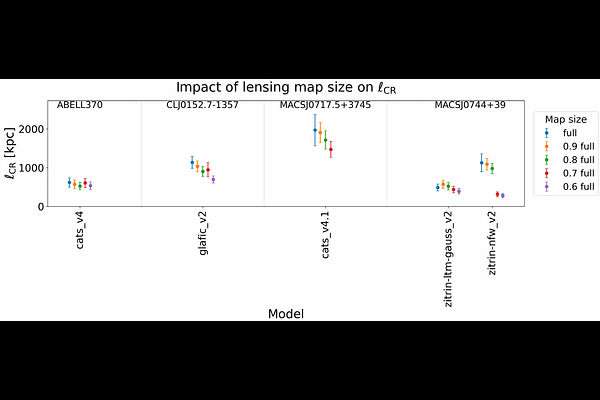
AbstractWe present the first application of Fourier-space coherence analysis between the lensing-reconstructed projected mass distribution and the X-ray-emitting intracluster medium to a sample of 49 observed galaxy clusters. Using publicly available HST convergence maps from the Hubble Frontier Fields, CLASH, and RELICS programs, together with Chandra X-ray imaging, we measure the scale-dependent coherence between the dark-matter-dominated surface mass density and the hot baryonic gas. We use the coherence length, l_CR, defined as the scale above which the two maps remain at least 90% coherent, as a diagnostic of cluster dynamical state. Across the sample, dynamically relaxed systems exhibit high coherence over a broad range of scales and small l_CR/r500, while disturbed and merging systems show a loss of coherence on intermediate and small scales, yielding larger l_CR/r500. The inferred coherence lengths show sensitivity to lens-model assumptions and to the heterogeneous extent of the available convergence maps. Nevertheless, the coherence signal remains physically interpretable and provides a stringent measure of dark-matter-gas alignment. Applying a conservative threshold, l_CR/r500 < 0.2, we find that only 16% of the sample is relaxed; this fraction rises to 41% for a more permissive threshold of l_CR/r500 < 0.4. Relative to previous X-ray and morphological classifications, we find a 24% disagreement, with the coherence method identifying more systems as dynamically disturbed. These results demonstrate that lensing-X-ray coherence provides a complementary, scale-resolved probe of cluster dynamical state, while highlighting the need for homogeneous, wide-field weak-lensing maps to control reconstruction and field-of-view systematics.