Discovery of Trailing Spiral Dust Alignment in the Dust Polarization of HL Tau at $λ= 2.1$ mm

Discovery of Trailing Spiral Dust Alignment in the Dust Polarization of HL Tau at $λ= 2.1$ mm
Yi-Wei Jerry Xu, Leslie W. Looney, Ian W. Stephens, Manuel Fernández-López, Zhe-Yu Daniel Lin, Zhi-Yun Li, Haifeng Yang, Austen Fourkas, Rachel Harrison, Ryo Tazaki, Satoshi Okuzumi, Carlos Carrasco-González
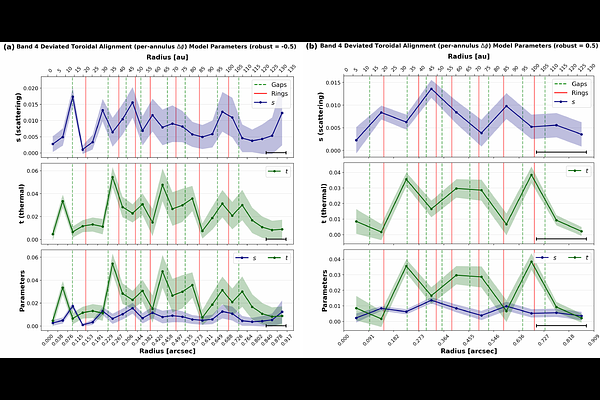
AbstractPolarimetric observations of protoplanetary disks at (sub)millimeter wavelengths constrain dust grain properties, dynamics, and alignment mechanisms. We present new high-resolution ALMA Band 4 (2.1 mm) polarization observations of HL Tau with spatial resolutions of $\sim$0.08$''$ (11.78 au) and $\sim$0.19$''$ (27.99 au). Linearly decomposing the polarization into contributions from dust scattering and thermal emission by aligned grains, we analyze the new Band 4 data and published high-resolution Band 7 (870 $μ$m) observations. Thermal emission from aligned grains dominates the polarization across the disk at Band 4, in contrast to the scattering-dominated Band 7, and both mechanisms vary radially with the disk substructures, consistent with expected optical depth variations. At Band 4, we detect a coherent angular deviation from purely azimuthal grain alignment, in which the streamlines of the alignment field yield trailing spirals with respect to disk rotation. A single global offset angle quantifies this deviation as $2.83^\circ\pm0.33^\circ$ and $4.10^\circ\pm0.09^\circ$ (statistical uncertainties) from two robust weightings, and the detection reaches a significance of $\approx7σ$ under conservative uncertainty estimates. This trailing orientation is consistent with aerodynamic ("badminton birdie-like") alignment driven by gas-dust drift near pressure bumps. However, under an axisymmetric disk velocity structure, this interpretation requires Stokes numbers two to three orders of magnitude larger than expected for the grains dominating the millimeter emission. At Band 7, the polarization angle is weakly sensitive to the alignment direction and exhibits a near/far-side antisymmetric structure that the model cannot reproduce. The Band 7 data therefore neither support nor contradict the Band 4 result.