Scientific Validation of the SPARC4 Pipeline: Multi-band Imaging, Polarimetry, and Photometric Time Series for Improved Characterization of Transiting Exoplanets

Scientific Validation of the SPARC4 Pipeline: Multi-band Imaging, Polarimetry, and Photometric Time Series for Improved Characterization of Transiting Exoplanets
Eder Martioli, Claudia V. Rodrigues, Julio C. N. Campagnolo, Francisco J. Jablonski, Ana Carolina Mattiuci, Fernando Falkenberg, Gustavo H. S. Santos, Marina M. C. Mello, Isabel J. Lima, Filipe V. M. Monteiro, Luciano Fraga, Leandro de Almeida, Diego Lorenzo-Oliveira, Hélio D. Perottoni, Laerte Andrade, Wagner Schlindwein, Denis Bernardes
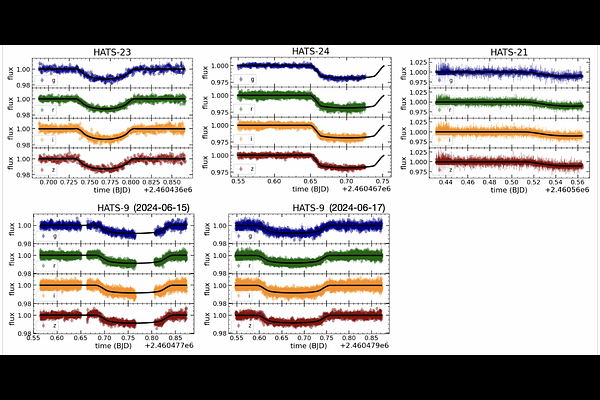
AbstractHigh-cadence multi-band imaging and polarimetry have important scientific applications in astronomy. Observations of transits of exoplanets are a particular application that requires robust data reduction and analysis. We present the SPARC4 Pipeline, a suite of routines developed to process photometric and polarimetric data obtained with the instrument SPARC4 installed on the 1.6 m telescope at Pico dos Dias Observatory, Brazil. The scientific data products, up to the generation of high-cadence time series, are demonstrated using observations of several transiting exoplanetary systems in both photometric and polarimetric modes. These observations are used to produce stacked calibrated images, yielding sub-arcsecond astrometric accuracy even in sparse fields. The time series of these fields enabled a photometric characterization of the instrument. Observations of polarimetric standard stars yield an instrumental polarization below 0.06% and a linear polarization accuracy of 0.2%. Furthermore, transit observations of seven exoplanets with host-star magnitudes in the range 10.2 < V < 13.9 demonstrate that SPARC4 achieves an average photometric precision of 0.02% for a 15-minute cadence and a polarimetric precision of ~0.02% over hours-long time series. Finally, we jointly model the SPARC4 light curves together with TESS data (or K2 data in the case of HATS-9) using a Bayesian MCMC framework to refine constraints on the physical parameters of the exoplanets, enabling a more accurate determination of orbital periods and planetary radii, and providing improved constraints on the orbital and physical parameters of these hot Jupiters.