The Merger-Driven Origin of the Vast Extended Stellar Disc Around the Andromeda Galaxy

The Merger-Driven Origin of the Vast Extended Stellar Disc Around the Andromeda Galaxy
C. Tsakonas, M. Arnaboldi, F. Hammer, Y. Yang, O. Gerhard, A. Burkert, D. Hatzidimitriou
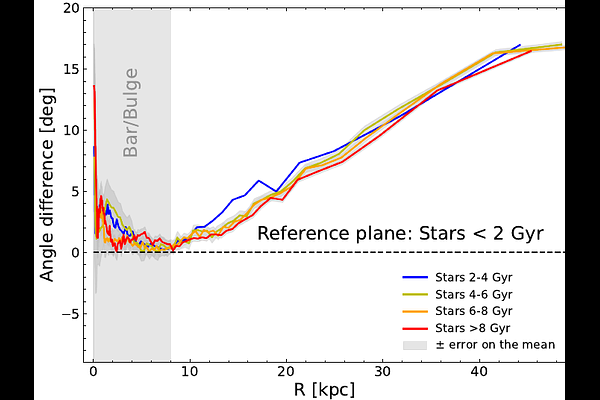
AbstractThe closest giant spiral, the Andromeda galaxy (M31), shows compelling evidence for a recent, gas-rich major merger event. Pronounced substructures in its inner halo and a kinematically hot stellar disc, whose star formation history shows a widespread star formation episode 2.5 Gyr ago, are telltale evidence that may be directly linked to a major (mass ratio 1 to 4) merger event that took place 2-4 Gyr ago. Spectroscopy of resolved giant stars in the remote outskirts of M31's disc revealed a vast extended structure that rotates with a circular velocity close to the HI gas. In addition, the spatial distribution and significant prograde rotation of two distinct, compact groups of globular clusters (GCs) in the disc outskirts are unusual for typical inner halo GCs. We employ an available N-body hydrodynamical simulation of a major merger that reproduces the morphology of the inner halo substructures, the age-velocity dispersion relation, and the star formation history in the disc. We compare model particles with resolved tracers in the M31 disc. To examine the evolution of the progenitor M31 disc -- that appears to get stretched, distorted, and warped due to the gravitational perturbation inflicted by the major merger -- we investigate the properties of the pre- versus post-merger discs of the simulated analog. The merger transforms the disc of the progenitor galaxy, which becomes kinematically hot and asymmetric. In addition, the post-merger disc gets stretched by almost a factor of 2, and its extent spans distances greater than 40 kpc. The stellar warp in populations older than 2 Gyr is characterized by a monotonic decrease of inclination with radius, with the outer stellar distribution appearing less edge-on at larger galactic radii. These results provide a comprehensive picture of the evolution of the giant disc of M31, the closest merger-inflicted massive galaxy.