Contrasting controls on tree methane emissions in upland and wetland forests

Contrasting controls on tree methane emissions in upland and wetland forests
Gewirtzman, J.; Hegwood, N.; Burrows, H.; Lutz, M.; Thompson, G.; Duncan, B.; Yang, M.; Jurado, S.; Marra, R.; Matthes, J. H.
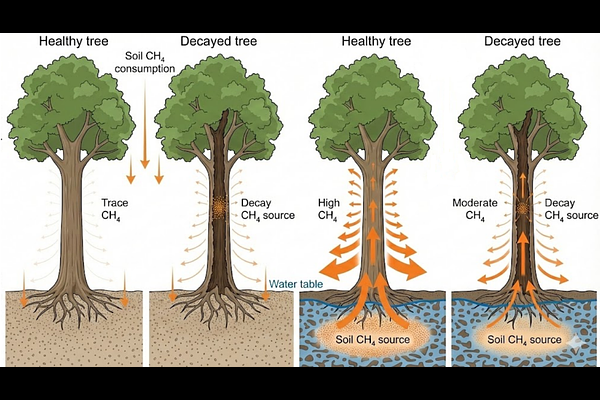
AbstractTrees can produce, consume, transport, and emit methane (CH4), yet the environmental controls and mechanisms underlying these fluxes remain poorly understood. We combined 1,640 stem-chamber observations (2023-2025) with tower-based meteorology, soil moisture and temperature networks, water table monitoring, and non-destructive tomography to test how hydrology, energy balance, species identity, and internal wood condition regulate stem CH4 flux. Wetland trees emitted approximately 40-fold more CH4 than upland trees (1.96 vs. 0.05 nmol m-2s-1). At the wetland, a three-way interaction between soil temperature, water table depth, and species explained 65% of flux variance, consistent with soil-derived CH4 transport through stems. The wetland specialist Nyssa sylvatica emitted an order of magnitude more CH4 than co-occurring generalists, likely reflecting flood-tolerance adaptations that enhance gas transport. In contrast, upland fluxes showed minimal environmental control (R2 < 9%), with most variance occurring as unexplained temporal variation within individual trees, a pattern suggesting competing methanogenic and methanotrophic processes operating near equilibrium. Internal wood condition, assessed via acoustic and electrical resistance tomography, had opposite effects across sites: decay increased emissions in upland trees, likely by creating anaerobic microsites for in situ production, while decay decreased net emissions in wetland trees, likely by impairing transport of soil-derived CH4 more than it enhanced in situ production. Together, these results indicate that the dominant controls on tree CH4 flux differ fundamentally between wetland and upland forests, underscoring the need to represent hydrologic setting, species composition, and tree condition when scaling forest CH4 contributions to regional budgets.