Cortical consequences of comorbidity: distinct effects of hearing loss and the 22q11.2 deletion on temporal processing in the auditory cortex

Cortical consequences of comorbidity: distinct effects of hearing loss and the 22q11.2 deletion on temporal processing in the auditory cortex
Lu, C.; Linden, J. F.
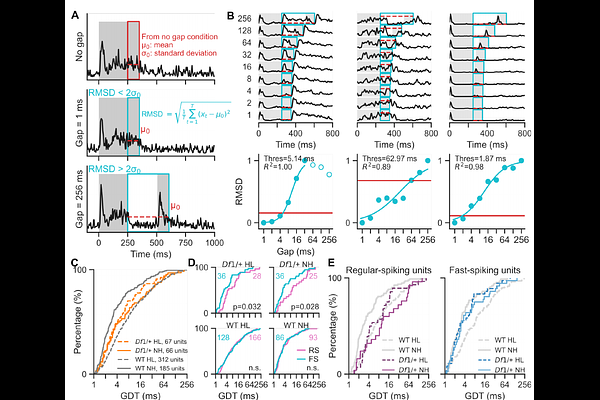
AbstractPeripheral hearing loss can cause auditory hallucinations and is considered a risk factor for psychosis, at least in genetically vulnerable individuals. To disentangle brain abnormalities driven by hearing loss and genetic risk for psychosis, we quantified auditory cortical temporal acuity in mice with or without hearing loss and with or without a genetic risk factor for psychosis (22q11.2 deletion). We recorded cortical activity while awake mice listened to loudness-adjusted gap-in-noise stimuli with varying durations of silent gap. Both hearing loss and the 22q11.2 deletion were associated with impairments in auditory cortical temporal acuity. However, hearing loss broadly impaired temporal acuity of neural population activity, while the 22q11.2 deletion had more subtle effects, selectively impairing gap duration thresholds in regular-spiking (putative excitatory) but not fast-spiking (putative inhibitory) neurons. Results suggest that auditory cortical consequences of comorbid hearing loss and genetic risk for psychosis are at least partially dissociable.