Plant-induced transcriptional plasticity diverges between generalist and specialist herbivores

Plant-induced transcriptional plasticity diverges between generalist and specialist herbivores
Wu, J.; Lin, Z.; Li, G.; Yu, W.; Zhang, Y.; Kou, Y.; Peng, P.; He, T.; Wang, Y.; Zhan, S.; Simon, J.-C.; Hogenhout, S. A.; Chen, Y.
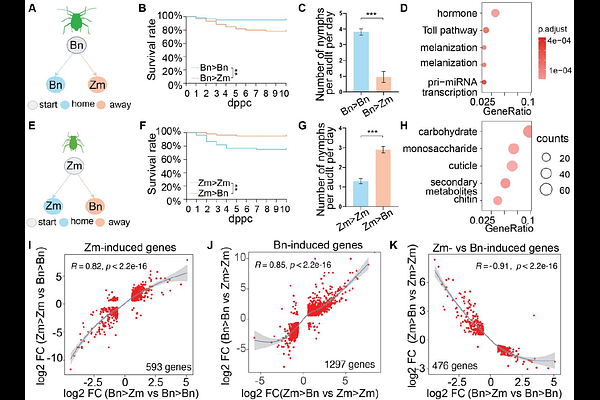
AbstractMost herbivores are specialized on particular host plants but some are generalists that can exploit distinct hosts. Generalists may have evolved adaptive transcriptional plasticity to cope with the defenses of the different hosts. However, the fundamental differences in plant-induced transcriptional plasticity between generalists and specialists remain poorly understood. Here, we investigated transcriptional plasticity of the generalist aphid Myzus persicae and two specialist aphids, Brevicoryne brassicae and Rhopalosiphum padi, by transferring them between Brassica napus (a host for B. brassicae but not for R. padi) and Zea mays (a host for R. padi but not for B. brassicae), both suitable hosts for M. persicae. Generalist and specialist aphids exhibited transcriptional plasticity coordinately in response to different plant species, but their gene expression patterns often diverged. Generalists suppressed plant-defense salicylic acid (SA) signaling in the host plants, while specialist aphids provoked it in nonhost plants. SA signaling had limited effects on gene expression in the generalist aphids, but significantly shaped transcriptional responses of the specialists. These findings underscore the fundamental differences in plant-induced transcriptional plasticity between generalists and specialists and highlight the critical role of plasticity directionality in insect adaptation.