Gravitational-wave constraints on $H_0$ are robust to (putative) redshift evolution in the binary black hole mass spectrum at current sensitivity

Gravitational-wave constraints on $H_0$ are robust to (putative) redshift evolution in the binary black hole mass spectrum at current sensitivity
Alessandro Agapito, Viola De Renzis, Michele Mancarella
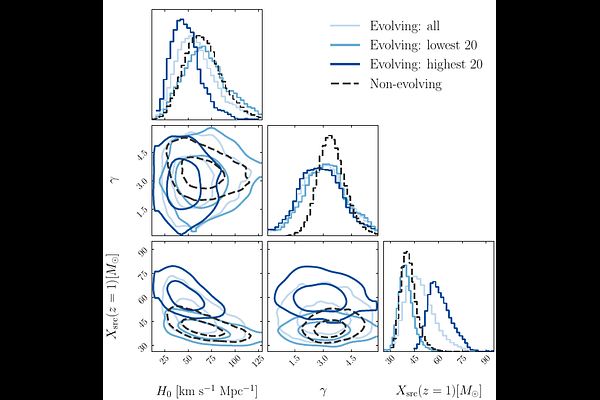
AbstractSpectral-siren cosmology constrains the Hubble constant $H_0$ using gravitational-wave observations of compact-binary coalescences. The method combines luminosity distances inferred from the waveform with redshift information statistically encoded in population features of the source-frame mass spectrum. Because the detector measures redshifted masses, structure in the intrinsic mass distribution acts as an internal ``ruler'', making the inference sensitive to assumptions about the population model. In particular, redshift evolution of the mass spectrum is widely discussed as a potential systematic for $H_0$ measurements. We revisit spectral-siren constraints with the GWTC-4.0 binary black hole catalog, explicitly allowing the main mass scales of a standard parametric mass model to evolve with redshift. We find no compelling evidence for evolution at current sensitivity. Allowing evolution produces a modest, non--statistically--significant shift of the $H_0$ posterior toward lower values, which we interpret with targeted posterior and event-level diagnostics. Importantly, the associated systematic uncertainty is subdominant to that induced by alternative redshift-independent descriptions of the mass spectrum, such as the number of spectral features and the functional form used to model them. Our results indicate that, at current sensitivity, spectral-siren constraints on $H_0$ are robust to redshift evolution of the mass spectrum within the flexibility explored here. Using injection studies, we show that this mild $H_0$ shift is reproduced when a non-evolving underlying population is analyzed with an evolving model, consistent with an over-flexible population description at the present signal-to-noise. The sign and magnitude of the shift can, however, depend on detector sensitivity and redshift reach as the population features become increasingly constrained directly by the data.