Apicoplast-derived isoprenoids are essential for biosynthesis of GPI protein anchors, and consequently for egress and invasion in Plasmodium falciparum

Apicoplast-derived isoprenoids are essential for biosynthesis of GPI protein anchors, and consequently for egress and invasion in Plasmodium falciparum
Bulloch, M. S.; Huynh, L. K.; Kennedy, K.; Ralton, J. E.; McConville, M. J.; Ralph, S. A.
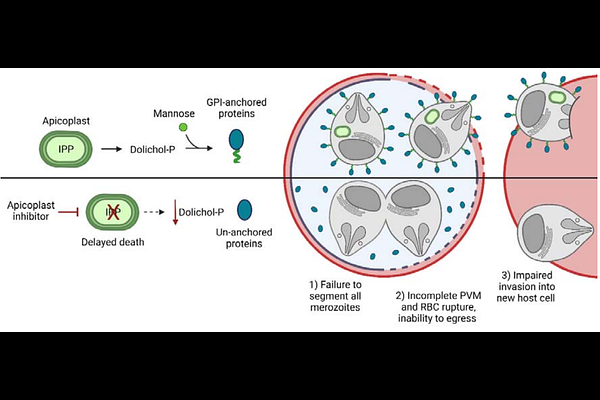
AbstractGlycophosphatidylinositol (GPI) anchors are the predominant glycoconjugate in Plasmodium parasites, enabling modified proteins to associate with biological membranes. GPI biosynthesis commences with donation of a mannose residue held by dolichol-phosphate at the endoplasmic reticulum membrane. In Plasmodium dolichols are derived from isoprenoid precursors synthesised in the Plasmodium apicoplast, a relict plastid organelle of prokaryotic origin. We found that treatment of Plasmodium parasites with apicoplast inhibitors decreases the abundance of isoprenoid and GPI intermediates resulting in GPI-anchored proteins becoming untethered from their normal membrane association. Even when other isoprenoids were chemically rescued, GPI depletion led to an arrest in schizont stage parasites, which had defects segmentation and egress. In those daughter parasites (merozoites) that did form, proteins that would normally be GPI-anchored were mislocalised, and when these merozoites were artificially released they were able to attach to but not invade new red blood cells. Our data provides further evidence for the importance of GPI biosynthesis during the asexual cycle of P. falciparum, and indicates that GPI biosynthesis, and by extension egress and invasion, is dependent on isoprenoids synthesised in the apicoplast.