Conspicuous shell shape plasticity across lake-stream habitats in a freshwater mussel (Pyganodon grandis)

Conspicuous shell shape plasticity across lake-stream habitats in a freshwater mussel (Pyganodon grandis)
Keogh, S. M.; Minerich, B. J.; Ohlman, L. M.; Pletta, M. E.; Scheunemann, A. E.; Schroeder, Z. K.; Secrist, Z. A.; Franzen, A. J.; Sietman, B. E.; Simons, A. M.
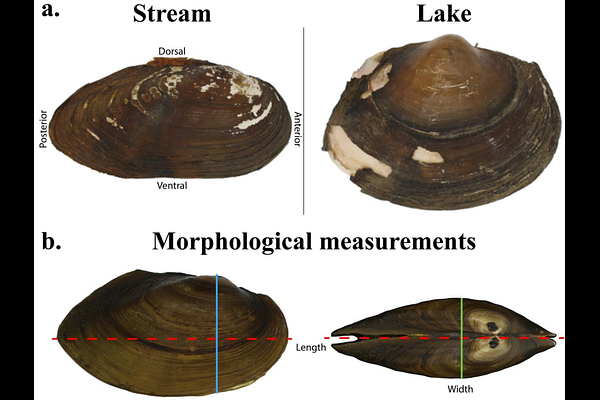
AbstractHydrodynamic forces and their absence appears to exert differential selection pressure between lake and stream populations, creating a tight fit between organismal phenotypes and their environments. Ecophenotypic variants may be the result from isolated genetic evolution or phenotypic plasticity, where a widespread genotype can produce multiple phenotypes dependent on the environment. Freshwater mussels possess a wide degree of morphological variation that frequently covaries with the environment, making them a good system to understand the mechanisms of ecophenotypic variation across hydrological conditions. We designed a two-year experiment where individuals from the same Pyganodon grandis maternal brood (half-full siblings) were reared at a controlled site and four natural sites involving one lake and three streams. At the end of the experiment, shell shape was quantified for recaptured (N=70), wild (N=206), and zoo-reared (N=305) mussels. Analysis of covariance found significant differences in shell shape between rearing sites, particularly between stream and lake habitats, but no shape differences were detected across the three stream sites. At two of the four sites, shell shape of recaptured individuals matched the morphology of wild populations. Genomic sequencing and parentage analysis identified 27 different fathers among recaptured individuals. Yet, no genetic differences were present between stream and lake habitats and there was no effect of parentage on shell shape. Taken together, phenotypic plasticity, over genetic differentiation, is identified as the primary mechanism of shell shape ecophenotypy. Plasticity may be a key adaptation for freshwater mussels and possibly provide a buffer against their imperilment in degraded habitats.