Inflaton Accretion onto Primordial Black Holes During Reheating

Inflaton Accretion onto Primordial Black Holes During Reheating
Jitumani Kalita, Debaprasad Maity
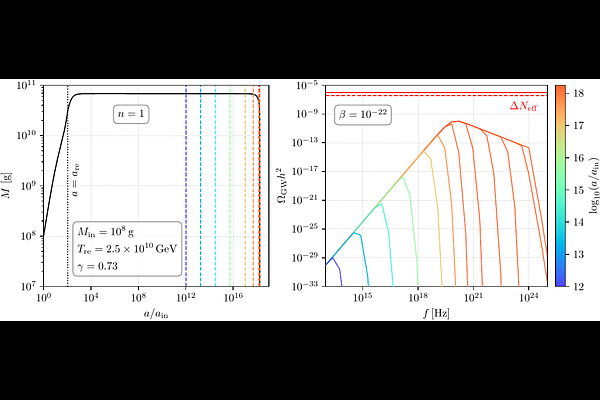
AbstractPrimordial Black Holes (PBHs) forming prior to Big Bang Nucleosynthesis evolve during the reheating epoch, an environment dominated by an oscillating inflaton field decaying into a relativistic thermal bath. In this work, we track the complete lifecycle of PBHs within this coupled inflaton-radiation background. Utilizing $α$-attractor E-models, we analytically anchor the reheating initial conditions directly to Cosmic Microwave Background observations. By matching exact scalar field solutions in a Schwarzschild spacetime to the cosmological far-zone, we derive the cycle-averaged mass accretion rate and couple it to the growing radiation bath. We find that this combined accretion induces a highly non-linear enhancement of the final PBH mass. Because the Hawking evaporation timescale scales cubically with mass, PBHs forming near their critical runaway limits experience a massive extension of their lifespans. Surviving deeper into the radiation-dominated era triggers a multi-order-of-magnitude amplification in their emitted Stochastic Gravitational Wave Background (SGWB).