The \emph{R}-process Alliance: A Bright, Strongly \emph{R}-process-enhanced Extremely Metal-poor Star Observed with GHOST

The \emph{R}-process Alliance: A Bright, Strongly \emph{R}-process-enhanced Extremely Metal-poor Star Observed with GHOST
Mohammad K. Mardini, Anna Frebel, Vinicius M. Placco, Anirudh Chiti, Manolya Yatman, Timothy C. Beers, Rana Ezzeddine, Terese T. Hansen, Erika M. Holmbeck, Ian U. Roederer, Charli M. Sakari
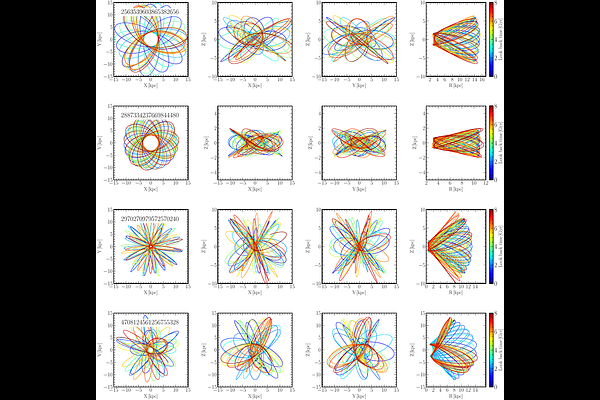
AbstractWe present a detailed chemical-abundance and kinematic analysis of four extremely metal-poor (EMP; [Fe/H] $\leq -3.0$) stars identified from \textit{Gaia} BP/RP data in our ongoing search for the most primitive stars. This includes a primary target, \textit{Gaia}~DR3~2563539603865382656 (hereafter G256353), a strongly $r$-process-enhanced star with [Eu/Fe]~$= +1.20$ and [Ba/Eu]~$= -0.64$. Our results are based on high-resolution, high-signal-to-noise GHOST spectra from Gemini-South. For the full sample, we statistically match the light-element abundances with those predicted from Population\,III supernova models. The ``best-fit'' model suggests massive progenitors with stellar masses of M$_{\star}\sim$ 20-30\,M$_\odot$. In addition, we determine orbital histories for all of the stars. We find that Gaia~DR3~2887334237669844480 appears to be kinematically associated with Atari, an accreted structure in the Galactic disk. This star has low abundance ratios of strontium ([Sr/Fe] = $-$1.09) and barium ([Ba/Fe] = $-$0.37), which supports an accretion origin. For G256353, we determine chemical abundances for 15 neutron-capture elements. We compare the observed heavy-element pattern for G256353 with that of the Sun, HD~222925, and two neutron star merger models. The $r$-process elements in G256353 align reasonably well with HD~222925, the scaled-Solar pattern (except for the first peak), and a recent predicted pattern associated with neutron star mergers. This consistency reinforces the universality of the main $r$-process across diverse astrophysical environments.